Brent residence, 24 Bay Dr, Three Arch Bay, designed by Aubrey St Clair, photo courtesy of Hunter Fuentes
Hunter Fuentes will discuss “Paradise Found: Early Laguna Beach Architects and Their Work,” at the Orange County Historical Society on March 13, 2025, 7:30p.m., at Trinity Episcopal Church, 2400 N. Canal St., in Orange. The public welcome!
Charles A Hunter designed house, 1938, photo courtesy of Hunter Fuentes
Laguna Beach gained early fame as an art colony, but art is a very broad category. While most associate art with painting and sculpture, one could take inspiration from Frank Lloyd Wright’s assertion that “The mother art is architecture.” In the April 1944 edition of Architect and Engineer magazine Sewell Smith, A.I.A., wrote, “Laguna Beach in normal times has more smart architects per square inch than any place I’ve ever visited ….” This presentation celebrates the work of a few of those “smart architects” whose work helped transition a summertime campground of ramshackle cabins and tents into a year-round city with world class public and private architecture. These include Aubrey St. Clair, Charles A. Hunter, Manfred DeAhna, and Jean Louis Egasse.
Hatheway Ford 1190 S,. Coast Hwy, Manfred DeAhna; photo courtesy of Hunter Fuentes
Hunter Fuentes works in the real estate industry for Zillow and is a resident of Laguna Beach. He developed a passion for the coastal town and its historic housing many years ago and has created a website called “Historic Laguna” (www.historiclaguna.com). The website celebrates the architects and architecture that help give the city its distinctive charm and personality.
Please join us to learn more from Hunter Fuentes about “Paradise Found: Early Laguna Beach Architects and Their Work,” at the Orange County Historical Society on March 13, 2025, 7:30p.m., at Trinity Episcopal Church, 2400 N. Canal St., in Orange. The public welcome!
Designed by Jean Louis Egasse; photo courtesy of Hunter Fuentes
Moulton Family Foundation president Jared Mathis and Moulton Museum Executive Director Dr. Elisabeth Lange will discuss the history of the historic Moulton Ranch at the next meeting of the Orange County Historical Society, on Thursday, January 8, 2026, 7:30 p.m., at Trinity Episcopal Church, 2400 N. Canal St., in Orange. The public is welcome!
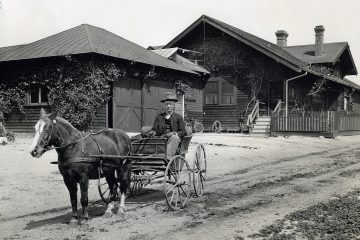
Lewis Moulton and his horse, Lady. photo courtesy of Moulton Family Foundation
In this illustrated lecture, the origins, growth, and eventual breakup of the Moulton Ranch operations will be brought to life, from the sheep herding beginnings to the cattle-raising end. Along the way, you’ll gain insights into the personality and character of Lewis Moulton and Nellie Gail Moulton, two pioneers of Orange County history, and their interactions with historical figures like James Irvine, Judge Richard Egan, and artist Edgar Payne. Come hear how the story of the Moulton Ranch influenced the development of Laguna Niguel, Laguna Hills, Aliso Viejo, Laguna Beach, Dana Point, and Mission Viejo.
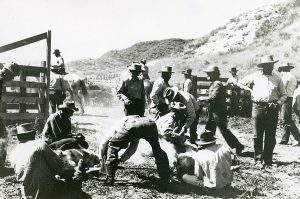
Branding cattle on the Moulton Ranch photo courtesy of Moulton Family Foundation
Jared Mathis is the President of the Moulton Family Foundation, and a leader in the cultural and education ecosystem of South Orange County. He was recently awarded the Madame Modjeska Visionary Leadership award from ArtsOC for his many philanthropic endeavors. His efforts uphold the family legacy of Lewis and Nellie Gail Moulton; he is one of their great-grandchildren and along with the rest of his family, actively supports the preservation of history and art in South Orange County, including the ranching heritage. He grew up on a ranch outside of Sacramento and has been in the commercial real estate field for most of his professional life.
A graduate of Mission Viejo High School, Dr. Elisabeth Lange went on to earn a PhD in Scandinavian Languages and Literature from U.C. Berkeley. She has been working in the museum field for over 30 years, first as a curator of an exhibition about the Vikings, then at a Scandinavian heritage museum in the Pacific Northwest, before focusing on local history museums. She became the Executive Director of the Moulton Museum in May of 2024, and is excited to be contributing to her hometown area historical awareness and preservation efforts.
Please join the Society and welcome Moulton Family Foundation president Jared Mathis and Moulton Museum Executive Director Dr. Elisabeth Lange as they bring the rich story of the historic Moulton Ranch to life at the next meeting of the Orange County Historical Society, on Thursday, January 8, 2026, 7:30 p.m., at Trinity Episcopal Church, 2400 N. Canal St., in Orange. The public is welcome!
Dr. Art Hansen, 2015 photo courtesy of Chris Jepsen
A great historian, a gifted teacher, a true friend to OCHS, a powerful voice for civil rights, and a man with a tremendous heart, Dr. Arthur August “Art” Hansen died on Oct. 29, 2025 after a long illness.
Art taught and guided students for 43 years as a professor of History and Asian-American Studies at CSU Fullerton. He was a trail blazer in gathering, studying, and writing about Japanese-American history for almost 60 years. His research specialization was resistance activity within the World War II Japanese American exclusion and detention experience. Art was also a leading light in the field of oral history; served on the boards of countless historical organizations, and provided a rare welcoming home for Orange County history in academia. In the process, he made the world a better place than he found it.
Art Hansen at OCHS Meeting 2011 with Phil Brigandi (standing) photo courtesy of Chris Jepsen
Art never hid his feelings. From furious indignation in the face of injustice; to high enthusiasm for his work and his favorite sports; to deep sadness at the loss of a friend; to effusive kindness, to love and empathy for all in his life, no one ever wondered where he stood.
His students found his vast knowledge, mentorship, and often lifelong friendship invaluable and inspiring.
“His care and concern was uplifting, joyous, and affirming,” said Tracy Smith Falk, who, like fellow OCHS board member Stephanie George, was lucky enough to have Hansen as both a professor and her boss.
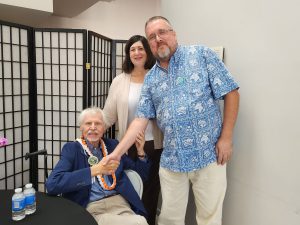
Art Hansen with Chris Jepsen and Stephanie George at JANM Nov 2023 photo courtesy of Chris Jepsen
“Art supported and participated in elevating and celebrating local history and local historians,” said Falk. “He mentored his students to be the best writers, researchers, oral historians, and people they could be. He taught them to seek out the full story and uncover all the experiences that made Orange County so diverse, interesting and unique. He led several conferences celebrating Orange County history and brought together wide groups of people who then discovered common interests.”
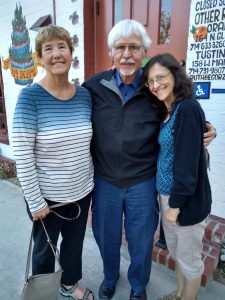
Debbie & Art Hansen with Tracy Falk, June 18, 2019 outside of Rutaborgz’s in Fullerton, CA. photo courtesy of Tracy Falk
Born October 10, 1938, in Hoboken, New Jersey, Arthur Hansen was born to Haakon A. & Anna Stover Hansen. (Art was always proud of his Norwegian heritage.) His older brother, Roy, also became a university professor.
Art’s love of baseball began early, and he always kept his grades up, so he could play. (He would later become a big fan of Cal State Fullerton baseball and always had season tickets.) Tracy Falk and Art could talk about Titan baseball and players for hours! Truth!
The Hansens valued education so much that Art’s father decided to move the family to California, so his boys could attend Cal Tech. Misunderstanding where Cal Tech was located, and confusing it with Cal Poly, they ended up near Santa Barbara, settling in Goleta after learning that the new UC Santa Barbara would soon be built there. Ironically, Art briefly attended Cal Berkeley before deciding to enroll in UCSB after all. There, he earned his BA, MA, and PhD in history.
While working on his PhD, he lived in Laguna Beach and taught at Tustin High School before accepting a position at California State University Fullerton in 1965.
Art met Debra L. “Debbie” Gold at CSUF and they were married in Maine in June 1977. Debbie also has a PhD in History and later taught library science classes at San Jose State University School of Information. The two were an impressive team and they split their time between their two homes in Yorba Linda and Los Osos.
Art taught at CSUF from 1966 until 2008, making a national name for himself as a professor of History and Asian American Studies and a central figure in the university’s Oral History Program (later called the Center for Oral & Public History or COPH and now The Lawrence de Graaf Center for Oral and Public History). He taught classes in local history, community history, and oral history methodology, as they related to Orange County and the world at large.
There aren’t enough terabytes on the Internet to list all his accomplishments and all the hats he wore during those years, but here are a few of them:
· Founding director of the Japanese American Project of the CSUF Oral History Program (1972)
· Founding faculty member of the Asian American Studies Program at CSUF
· Director of the Center for Oral and Public History, CSUF
· Visiting Professor, California Polytechnic State University, San Luis Obispo (1979-1980)
· Editor, Oral History Review (1980-1987)
· President, Southwest Oral History Association (1991-1992)
· President, Oral History Association (2002-2003)
· Senior Historian, Japanese American National Museum (2001-2005)
· James V. Mink Oral History Award-winner, Southwest Oral History Assoc. (1988)
· Named Outstanding Teacher, College of Humanities & Social Sciences, CSUF (1996-1997)
· Named Outstanding Faculty Member, College of Humanities & Social Sciences, CSUF
· Distinguished Faculty Member, College of Humanities & Social Studies, CSUF (2001-2002)
· Distinguished Lifetime Achievement Award from the Association for Asian American Studies (2007)
He was also a prolific writer and editor. Just a few of his many, many publications included,
· Reflections on Shattered Windows: Promises and Prospects for Asian American Studies (1987, co-editor)
· Japanese American Evacuation World War II Oral History Project [5 volumes] (1992-2005, editor/author)
· Barbed Voices: Oral History, Resistance, and the World War II Japanese American Social Disaster (2018, author)
· Manzanar Mosaic: Essays and Oral Histories on America’s First World War II Japanese American Concentration Camp (2023)
· Nisei Naysayer: The Memoir of Militant Japanese American Journalist Jimmie Omura (2018, editor & introduction)
· Beyond the Betrayal: The Memoir of a World War II Japanese American Draft Resister of Conscience (2022, editor)
· A Nikkei Harvest: Reviewing the Japanese American Historical Experience and Its Legacy (2024, author)
Many also remember Art raising money from the Japanese American community for the building of the 8,500-square-foot Orange County Agriculture and Nikkei Heritage Museum at the Fullerton Arboretum (at CSUF), which opened with an excellent exhibit in 2007. But despite promises made, the University scuttled the museum as soon as Art retired and they had the donations in hand. This infuriated and saddened Art.
In retirement, Art served as Emeritus Professor of History and Asian American Studies at CSUF; wrote, edited and lectured extensively; continued to serve as historian for the Japanese American National Museum; and won the Manzanar Committee’s 2014 Sue Kunitomi Embrey Legacy Award.
At one point in his later years, he suffered a heart attack while delivering a presentation at CSUF. True to form, he insisted on finishing his program before being taken to the hospital. He recovered from the heart attack, but there would be other health challenges ahead. Through it all, he continued to research, write, and edit – even in the last week of his life.
Dr. Art Hansen will be truly missed by all who knew him, including the Orange County historical community. His good work, however, will continue, through the oral history programs he started, through the interviews he conducted, through a library’s-worth of articles and books he wrote, and through the organizations he helped create and build. He will also live on through his students and their work, and through those who in turn, learned from his students. Art will always be with us.
Thanks to Chris Jepsen, Tracy Smith Falk, Stephanie George and Dr. Debra Gold Hansen for their help with this article.
SUGGESTED VIEWING:
Nisei Naysayer Discussion at JANM with Art Hansen (2018)
Art discusses journalist James Omura, JACL leader Mike Masaoka, and war hero Ben Kuroki in the film “Conscience and the Constitution”
Art and Lawson Fusao Inada talk with the family of WWII Japanese American Draft Resister Yoshito Kuromiya
Art’s comments at the 2023 Manzanar Pilgrimage
“Voices of Resistance” presentation to the Nichi Bei Foundation (2019)
Keynote address, 39th Annual Manzanar Pilgrimage (2008) – Part 1
Keynote address, 39th Annual Manzanar Pilgrimage (2008) – Part 2
A Preview of Art Hansen’s Book “A Nikkei Harvest”
Part of OCHS’ Tribute to Phil Brigandi, including Art Hansen
Sample a few of the oral history interviews Art conducted for DiscoverNikkei in the early-to-mid 2000s
Recent Orange County history books will be discussed by their authors at the Orange County Historical Society’s Authors Night on Thursday,November 10, 2022, 7:30p.m., at Trinity Episcopal Church, 2400 N. Canal St., in the City of Orange. After their presentations, you’ll have time to meet the authors, ask questions, buy books, and have those books signed. The public is welcome. Featured books include:
Author’s Night 2008
SAVING UPPER NEWPORT BAY
The gist of this book’s story is right in the title: Saving Upper Newport Bay: How Frank and Frances Robinson Fought to Preserve One of California’s Last Estuaries. Author Cassandra Radcliff began volunteering at Upper Newport Bay in 2014 after visiting the park for birdwatching. She is now a Volunteer Naturalist, recipient of a OneOC Spirit of Volunteerism Award (2019), and Vice President of the Newport Bay Conservancy Board of Directors. She currently lives in south Orange County and works for Walter Foster Publishing, a book publisher founded in Laguna Beach in 1922.
A PEOPLE’S GUIDE TO ORANGE COUNTY
This alternative tour guide “documents sites of oppression, resistance, struggle, and transformation in Orange County, California.” The book’s wide array of topics reflect local diversity, segregation, privatization, the struggle for public space, migration, youth cultures, labor, and much more. Two of the contributing authors will join us for the evening. Dr. Elaine Lewinnek is professor of American Studies and chair of the Environmental Studies program at CSU Fullerton. Dr. Thuy Vo Dang is Curator for the UC Irvine Libraries Southeast Asian Archive and Research Librarian for Asian American studies and is co-author of the book, Vietnamese in Orange County.
GOOGIE MODERN: ARCHITECTURAL DRAWINGS OF ARMET DAVIS NEWLOVE
OCHS’ longtime friend, author and architectural historian Alan Hess presents this highly visual volume of plans and concept drawings from the private archives of the Armet Davis Newlove firm. This architectural firm created what became known as “Googie Modern,” capturing the optimistic and forward-thinking mood in post-war America and setting the bar for what would become Mid-Century Modern style. Hess has written more than nineteen books on Modern architecture and urbanism in the mid-twentieth century. This included, beginning in the 1980s, the first serious works on Southern California’s own Googie architecture.
SUITE ALICE OF RIVERSIDE, TAHOE AND LAGUNA
Alice Miller Richardson – the sister of Mission Inn founder Frank Miller — started as a hotel manager in 1874. She proved a natural and over time ran multiple world-class hotels (then “a man’s job”), setting new industry standards along the way. Friends frequenting her waterfront Laguna Beach home included prominent artists, cooks, actors, presidents, architects and poets. Few knew she was one of California’s most successful businesswomen. Author Barbara Ann Burns has long been in charge of training docents at the Mission Inn. Initially, she thought Alice had simply worked in her brother’s famous Inn. Over time, she learned that Alice was really the one in charge.
LAGUNA DIARY
Author Richard Leslie Brock’s new historical novel is a well-researched and well-remembered depiction of mid-century Laguna Beach. Laguna Diary is about secrets revealed by a long-lost diary written by a boy’s father who abandons his family. Many of the secrets are about local lore unique to Laguna and they guide the boy into adulthood. Others provide clues to the father’s disappearance. Locals will recognize long-gone local institutions, buskers, cults, West Street Beach, Aliso Creek Pier, the death of Killer Dana, and much more. There’s even a connection to Richard Egan of San Juan Capistrano. Brock is a historian, folklorist, novelist and attorney.
THE KINDNESS OF COLOR
Author Janice Munemitsu gave a presentation to OCHS earlier this year about her book, The Kindness of Color: The Story of Two Families and Mendez, et al. v. Westminster, the 1947 Desegregation of California Public Schools. She returns this evening to sell and sign her book and answer your questions. The book tells the true story of two immigrant families (Mendez and Munemitsu) who came to the U.S. for better lives, only to face their own separate battles against racism during the 1940s. The friendship of these two families would help lead to the desegregation for all the school children of California in 1947.
Taken Oct. 29, 1921, in Laguna Beach. Dr. C. D. Ball, the Orange County Historical Society’s first president, is seated with a cane. On his left is Judge J. E. Pleasants, next to him is Laguna artist Anne Robinson. Directly behind Dr. Ball is William McPherson. Two over from McPherson is S. M. Davis, former Orange County District Attorney.
Thursday, January 10 , 2019
Meeting Begins at 7:00pm
Program at 7:30pm
Trinity Episcopal Church, 2400 N. Canal St., Orange, CA
This month we will kick off our Centennial Celebration with a look back at the history of the Orange County Historical Society. Historian and OCHS Board Member, Ellen Bell will take us back to our founding year of year of 1919. We’ll revisit the time and place and learn about a young county that was just starting to understand the importance of preserving its own history.
Back then, there were no Special Collections Libraries, or Oral History Archives or History Rooms. The county was young, but early pioneers were aging. In April of 1919, Terry Stephenson, editor of The Santa Ana Register began a weekly “Old Hunter Series,” where he shared tales of old pioneers of the Santa Ana Mountains. The articles inspired Santa Ana attorney Samuel M. Davis who called a meeting to “discuss the creation of a local preservation society.”On May 28th, 1919, the Orange County Historical Society was born. The rest, as they say, is history.
Come join us as we travel the 100-year timeline and mark the many “firsts’ of our society. Don’t miss the kick-off evening of this year-long party as we celebrate the rich heritage of the Orange County Historical Society, and a legacy of preservation that continues today!
From orange-shaped citrus stands, to the Brown Derby, to the giant dinosaurs of Cabazon, nothing says “Southern California” quite like our crazy architecture. Join author and historian Jim Heimann on a virtual tour through our audacious and innovative landscape of eccentric buildings at the Thurs., Nov. 8 meeting of the Orange County Historical Society at 7:30p.m. Heimann will discuss programmatic architecture (e.g. “buildings that look like things”): a unique and enduring expression of American vernacular architecture.
Americans’ predilection for wanderlust at the beginning of the automobile age prompted inventive entrepreneurs to address this new mode of transportation. Starting in the 1920’s, attention-grabbing buildings began to appear that would draw drivers going 35 m.p.h. to stop in for snacks, provisions, souvenirs, or a quick meal. The architectural establishment deemed them “monstrosities” and dismissed them. Yet they flourished, especially along America’s Sunbelt, as their owners heeded a creative impulse and constructed giant owls, dolls, pigs, ships, coffee pots, and fruit. Their symbolic intent was guileless, prompting their slow deletion in a chapter of America’s social and architectural history. Yet photographic documentation of the past 40 years has assured their place in the architectural hierarchy and has prompted this building type to continue to flourish.
Jackson Ice Cream, Laguna Beach, 1920s
Southern California native Jim Heimann is a historian, cultural anthropologist, author, educator, and the executive editor of Taschen Publishing America. He has been active in the arts field for the past 45 years publishing numerous books and articles and is a faculty member of Art Center College of Design, Pasadena, where he has taught since 1988. A greatly expanded and beautifully illustrated third edition of his classic book, California Crazy: American Pop Architecture (first published almost 40 years ago) was released earlier this year.
Our meeting will be held on Thursday, November 8th, at 7:30 pm at Trinity Episcopal Church, 2400 N. Canal St., Orange.
Parasol Coffee Shop, Seal Beach
As always, members and the general public are cordially invited to attend.
Community History Anaheim Colony Historic District Huntington Beach History Mission Viejo Heritage Committee Olive Through the Ages – History of Olive,[…]
Join us for a hike to one of the last remaining World War II structures built as part of an elaborate defense system that stretched from just north of Laguna Beach to the Palos Verdes Peninsula. Completed in about 1943, the station–commanding a view of the coastline from Dana Point to Long Beach–was designed to house a crew of four to observe and take readings on enemy ships in conjunction with six other stations.
This four mile round trip hike will be led by Crystal Cove State Park’s interpretive naturalist Rick Connella who writes, “The beauty and panoramic views are magnificent and will entrance you.”
The elevation gain is about 800’ to the site and about 1000’ for the round-trip loop. The degree of difficulty is described as moderate, with a few very steep and rough portions.
When: Saturday, November 1, 2014*
Time: 9:00 a.m.
Length: about 3 hours.
Bring: plenty of water and snacks.
This hike is limited to 20 people.
Reservations are a MUST and should be made by following this link:
Lorraine Passero, author of Clara Mason Fox: Pioneer, Painter, and Poet of Orange County, will present the story of the O.C. pioneer on Thursday, May 9, 2013, 7:30 p.m., at Trinity Episcopal Church, 2400 N. Canal St., in Orange.
More than 50 years after Clara’s death, a box found in an attic helped to piece together the narrative of this remarkable woman. Clara’s story, expressed through her art, poetry, and writings tells us that the Mason family left Illinois in the 1880s and were among the first settlers of Silverado Canyon. A true pioneer of her era, Clara served as perhaps the first schoolteacher in the canyon, and became an early Laguna Beach artist. She eventually travelled alone to New York City to study art at Cooper Union. After marrying local rancher George Fox and moving to El Toro, Clara was the first to write a book chronicling the history of that town.
Lorraine Passero’s book offers readers insights about Orange County’s homesteading days, life during turn-of-the-century New York City, and a young woman’s personal challenges. Excerpts from Clara’s letters and poetry, as well as her art, give us insight into her talents and observations of life.
In 2010, a serendipitous discovery of more than 150 of Clara’s botanical watercolors—some dating back to 1894—were discovered in cabinets filled with plant specimens at the Rancho Santa Ana Botanic Garden in Claremont, California. These watercolors are currently part of the exhibit “When They Were Wild: Recapturing California’s Wildflower Heritage” (March 9 – July 8) in the MaryLou and George Boone Gallery at the Huntington Library in San Marino. The exhibit also includes work by other artists, including Alice Brown Chittenden (1859–1944), Ethel Wickes (1872–1940), and Milford Zornes (1908–2008).
A native of New York City, Lorraine Passero earned her elementary education degree at Long Island University. While attending San Diego State University she met her future husband, Jon Seeman, a sculptor and a great-great nephew of Clara Mason Fox. Lorraine received a master’s degree at Mount Saint Mary’s College in Los Angeles. During the course of her teaching career, Lorraine was the recipient of numerous awards including the Japan Fulbright Memorial Fund and The New York Historical Society National Teachers Institute Award. The Orange County resident is currently developing a second career as an artist and author.